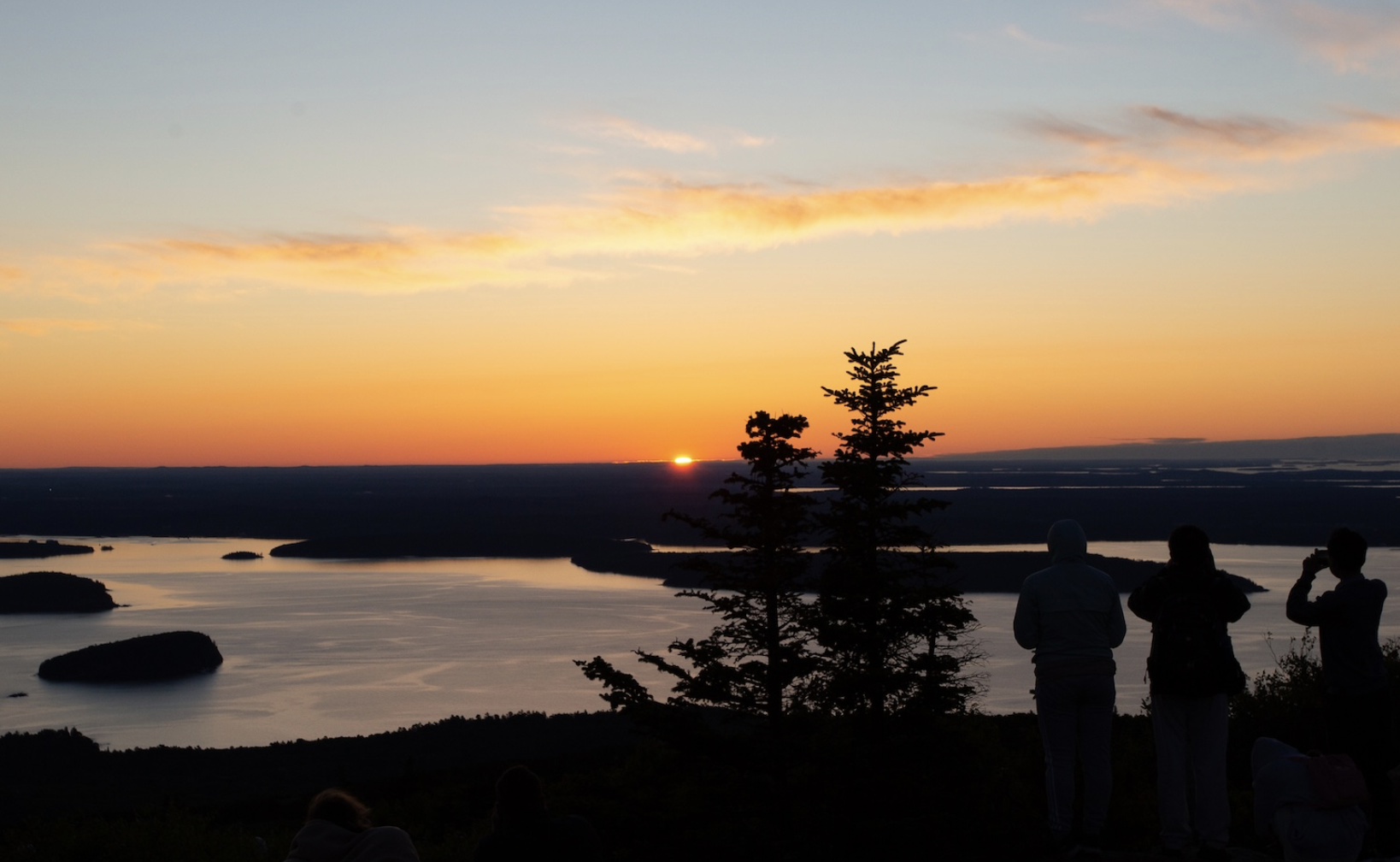
Cadillac Mountain

image by Casey Barber

Under the luminous moon 
of the equinox, I travel this
quiet New England byway.
Behind me, a small possum sits
in a twist of brush and bramble.

She’s praising Something
– herself, fate, or God -
for running the gauntlet
of my tires; how she did it
is a question for minds
bigger than hers or mine.

Yet I’ve told her story out of turn:
First were frantic breaths
and heaving tremors
as she recalled her maze of terror:
the swirling black teeth,
the cold asphalt on her pads,
the shocking graze of metal against
her coarse coat.
.
It's a shame that possums
are solitary animals.
No one was there, watching
wide-eyed and breathless;
No one was there, applauding
the blind luck and dumb moves
that got her to the other side.

I drive on.
North of me, at the end of another road,
a dark sentinel gazes into blackness;
where horizon meets the sea,
Cadillac Mountain waits for the sun.

I return.
It's pre-dawn, fourth of July;
you slumber in your sleeping bag
as I pass under festive banners
on my way to the trail.

I stumble up the mountain
to wait for the sunrise, my soul
bounding and rebounding
against your world’s low atmosphere.

I arrive in the final opaque moments;
others are here too:
in pairs in groups in close proximity.
We wait, and I wrap my arms
around myself.

There was nothing I could do
to stop that certain light;
the urge to bolt seized like a spasm,
and I tumbled across, blind and careless,
careening into coldness,
into tangle, into truth.

No one saw me when I crossed over;
the clapping I heard was not for me,
but for the first rind of light that sent
shimmers across the waters.

I sat, far into the new day,
breathing the air
and blinking at the light.

That night,
while everyone watched fireworks,
I embraced Independence Day.

Zippered Pride

Let me tell you what I can do.

I can drive my standard
down Bread Loaf mountain
and never touch the brakes
until the last defiant curve.

I can find sand dollars
with my toes and
hermit crabs with my fingers
and slide them into to a child’s bucket.

I can make a cookie -
You’d choose it for your last meal:
Crisp edges and a chewy center,
Butterscotch Oatmeal Walnut

I can make a meal
from empty cabinets
and fill a dining room table
on Easter and Thanksgiving.

I can change a tire,
Unclog drains,
Find studs,
Replace filters.

I can make chicken soup,
Send that card,
Pay those bills,
Remember everyone’s birthday.

And.

I cannot leave my house
with my dress fully zipped.
And at the end of all I do,
I cannot unzip myself.

It all comes down
to this one small gesture,
the small seedling moment
that rifts my stony, stoic existence.

It is the weight of the hand
against my back, tugging downward,
breaking me open,
It is all that follows.

And all that I can do
Is silenced
by the quiet clicks
of the one thing
I cannot.

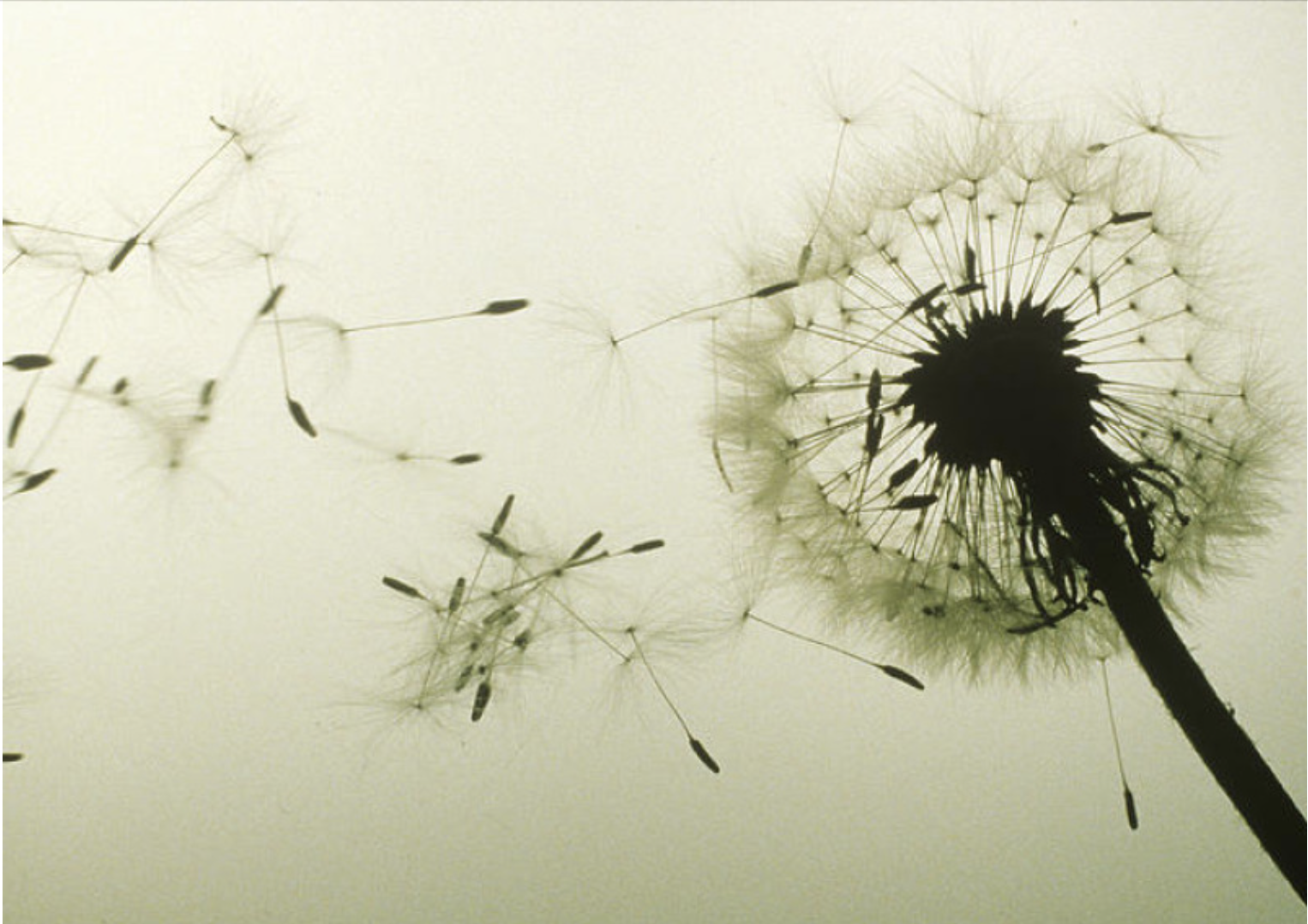
The Art of Letting Go or, Stormy with a Chance of Seedpods

Photo art by Tom Branch

Letting go is like
Letting go of honey,
or letting go of dirt
under your fingernails after
an afternoon in the garden

Letting go is like
dropping a hot-handled skillet,
the imprint bubbled into your palm.

Or it is like lingering.
It is losing the scent
from a lover’s pillow.

It is the slow melt.

It is marking each labored breath
while feeling the planet’s rotation
under your feet.

Letting go is like blowing
a dandelion into the wind,
a contrary wind,
that whisks tiny tailed wisps
up your nostrils
under your eyelids
and into your ears.

Letting go is artless wretchedness.
There’s no beauty in it:
It is a roll in the mud and
a stumble through the briars.
But when you emerge,
your dented grace
and seedling peace
will be enough.

SAME OLD CABINET

Same Old Cabinet

In my kitchen, the cabinets began
springing off the wall.
Behind their closed, crooked doors,
seams had separated, and
steadfastness slipped away.

I moved deliberately,
opening doors with care,
stacking dishes gently.
I was tentative and alert,
eyes fixed on the cabinets’
shuddering sinews.
I wanted to bolt.

The weight of their fall, I knew,
would break me with it.
I imagined myself,
broken boxes where
my body used to be,
The wicked witch, only
striped socks and pointy shoes
to show for myself.

Even then, I doubted. I discussed
the situation with friends: “Are you
seeing what I’m seeing?” They nodded
and said, “We told you this already.”

I called the carpenter. I learned the cabinets
could be fixed, but first I’d need to empty them.
I weighed out danger verses
upheaval before telling him yes.

On all my flat surfaces, I built
wobbly stacks of plates and glasses,
jars and cans. The carpenter left behind
gouged walls and a fine dust
that filled my lungs.

Outside the kitchen’s empty, ugly landscape,
I organized the chaos, carving out space
to eat, and work, and dream.

In the carpenter’s shop, the shaky seams
met with glue and screws,
And I came home to find the cabinets
hanging again, straight and true

That day, and the days following, I had no
desire to put everything back.
Then, I couldn’t quite remember
how it had been. I suspected the cabinets
had been mounted upside down.

Eventually I tucked it all back in.
The new arrangement was different,
but I had to admit, it was good,
and maybe, even better, than before.

My space is now safe and strong and stable.
Nothing angles out at me, threatening
to hurl a single dish or all of them at once.

But now, every time I look into the kitchen,
I still see those cabinets leaning.
I’m still running my hands along the seams
between the cabinet and the wall.

I’m not sure how long before
my eyes believe what my head knows;
how long before I stop waiting for
it all to come crashing down.

And now you’re home too, this old shape of you
that’s had a fair amount of screw and glue
to stand
you
up
straight.

I’ve gotten used to my peaceful cairns,
and I’m not sure how to move about you anymore.
I’m sorry to say, that most days,
I don’t even want to try.

What my head knows and
my heart believes are two different things.
When I look at you,
you’re still swaying.

-Chali Davis