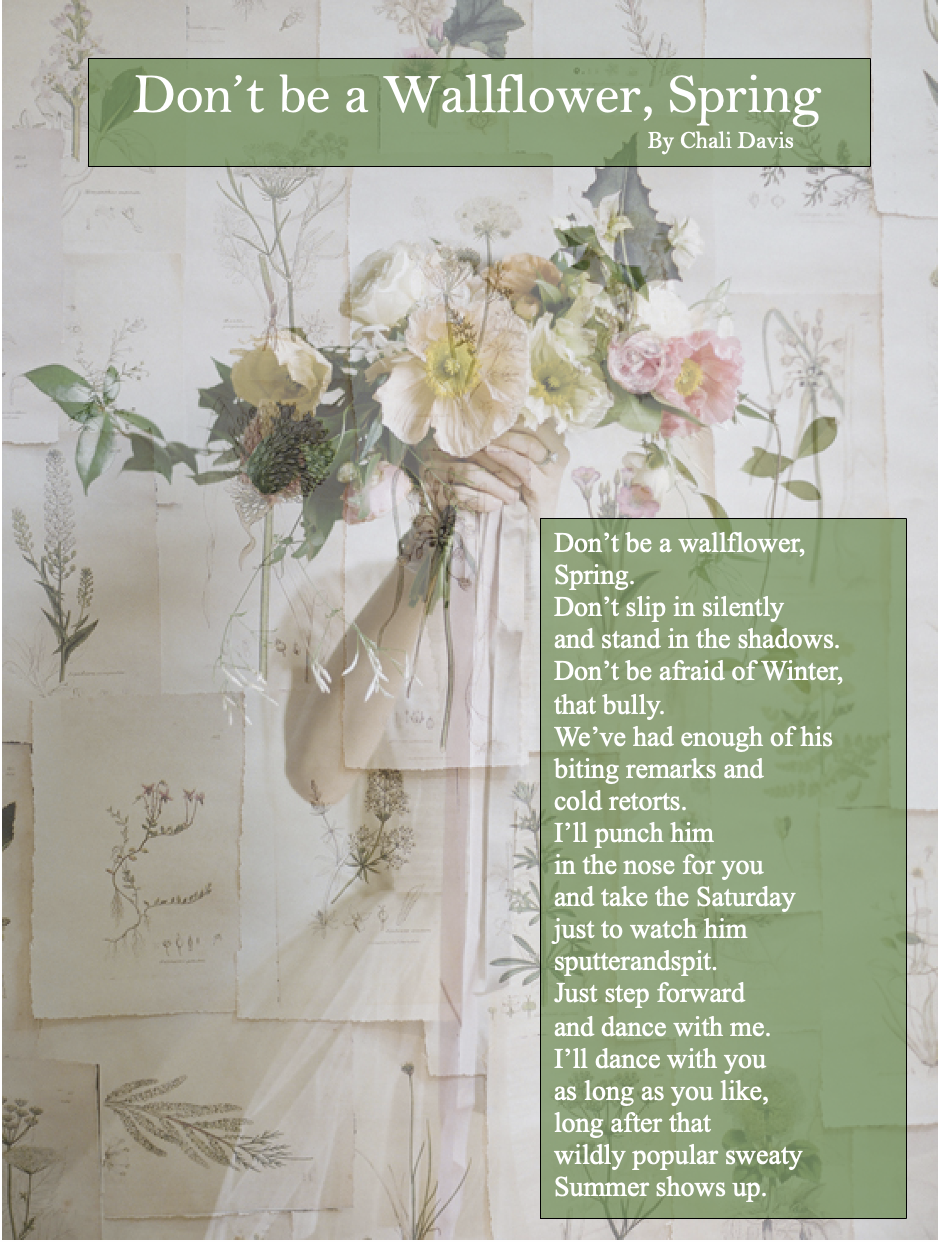
March 21
Image
Reply

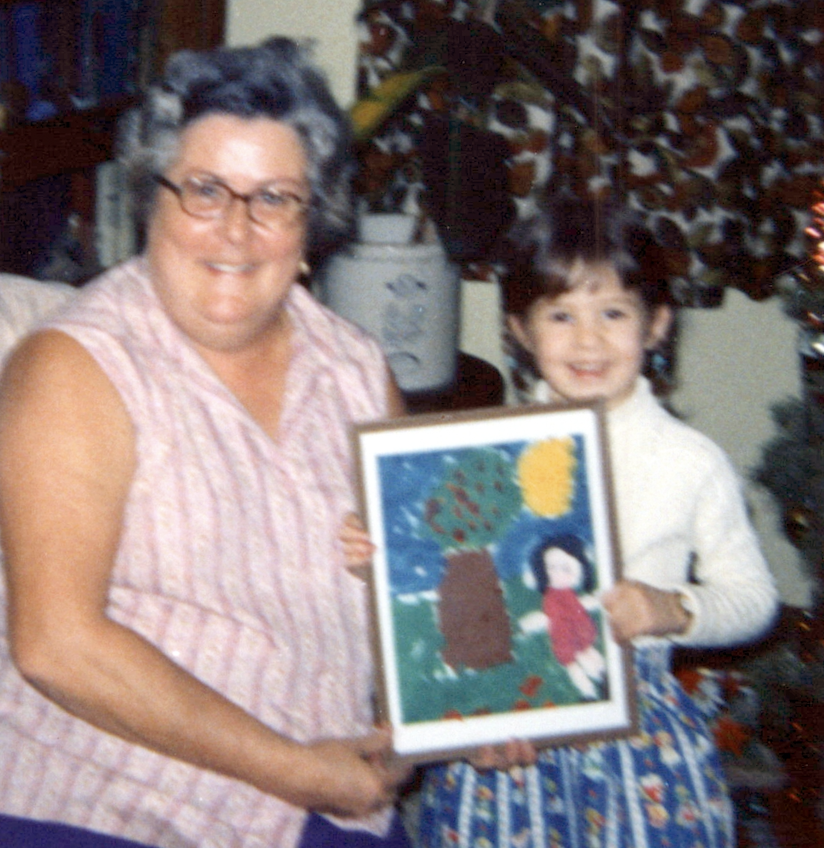
In loving memory of Iva LaRue

As the Israelites traveled through the desert wilderness, the presence of God was manifest in a cloud by day and a pillar of fire by night.   Exodus 13:22

In the summer of 1982
God sat at a card table,
poodles at her ankles,
cocked cigarette in hand,
setting her nine cards
in vast array.

The summer of '82
was slow and hot and humid,
and we traveled through
the days card by card,
pacing ourselves by
trumpeted proclamations
Let’s Make a Deal!
Wheeeeeel ooofff Fortune!
and the whispers of
Luke and Laura.

When the news ended,
when the last card played,
when the air was thick and stale,
and we were tired of each other,
I trudged away, smelling of smoke,
and entered my
quiet house.  If anyone
was there, they knew
I had been with God.

Every morning, I’d return,
crossing the wasteland,
my house to God’s,
to sit before the altar
of three channels
and eat toast to
the happy banter of others
Good Morning, America.

The incense of tobacco,
bright and fragrant,
rose into the crisp
morning air, air
cleansed by the
light of the moon.

Sometimes God thundered
about daughters-in-law.
Sometimes God quaked
about the silent phone line,
the boys who seldom called.
Sometimes God wept
for the sins of the family,
and sometimes God spoke
in a still small voice,
It’s going to be ok, honey
Oh baby, I’m so very sorry

An ember by night,
the Cloud of Presence by day,
In the wandering wilderness
of that season,
God Was.
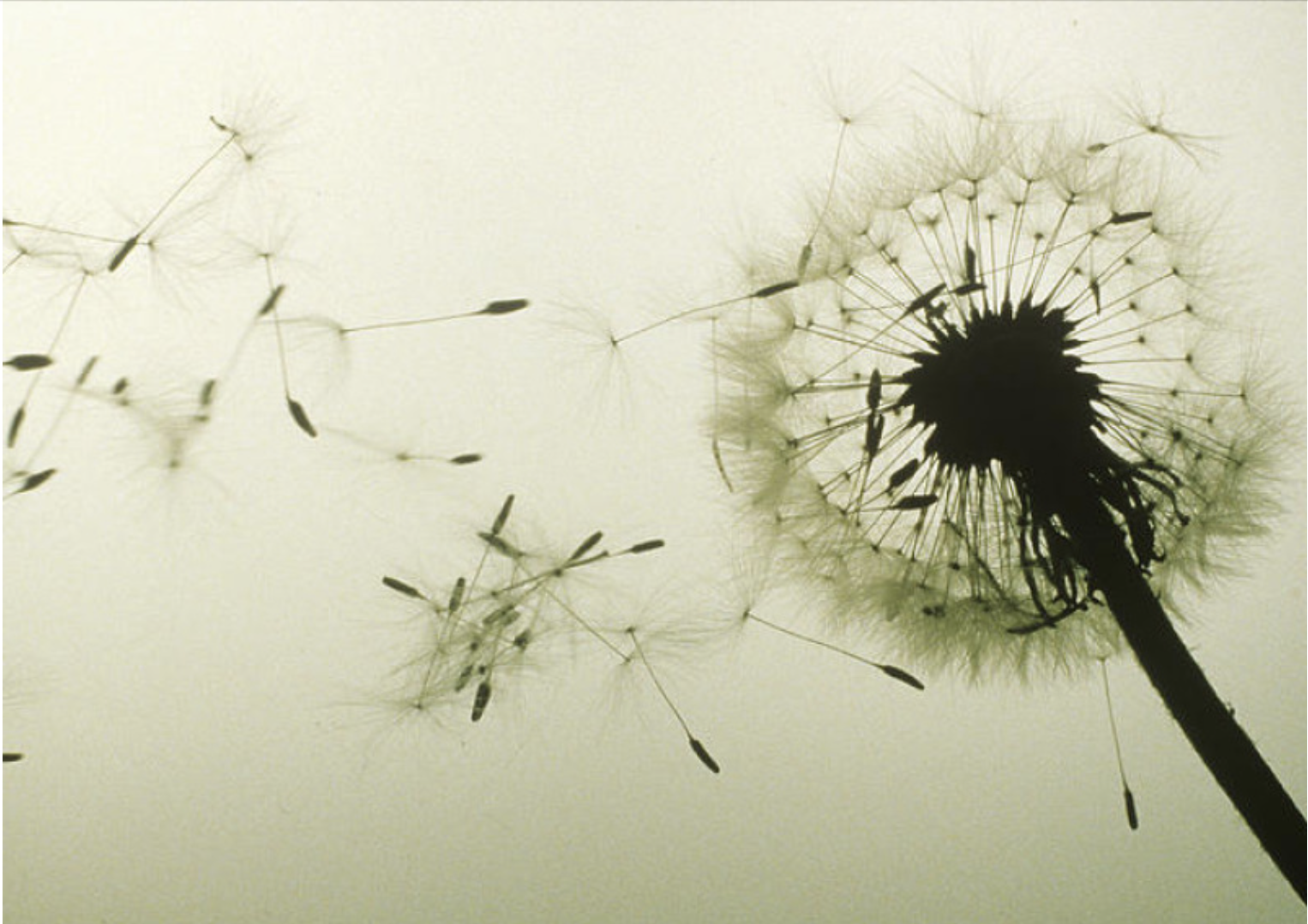
Photo art by Tom Branch
Letting go is like
Letting go of honey,
or letting go of dirt
under your fingernails after
an afternoon in the garden

Letting go is like
dropping a hot-handled skillet,
the imprint bubbled into your palm.

Or it is like lingering.
It is losing the scent
from a lover’s pillow.

It is the slow melt.

It is marking each labored breath
while feeling the planet’s rotation
under your feet.

Letting go is like blowing
a dandelion
into the wind,
a contrary wind,
that whisks tiny tailed wisps
up your nostrils
under your eyelids
into your ears.

Letting go is artless wretchedness.
There’s no beauty in it:
It is a roll in the mud and
a stumble through the briars.
But when you emerge,
your dented grace
and seedling peace
will be enough.

He remembers how, when the last guests left,
the house settled in to stillness, and how his

Mother sat on the porch swing, quiet hands folded,
pushing back and forth into the silent night.

The pendulum of time always moved, forward,
forward, but his father was snared

In the backward drag, and for that he was
serving the life sentence of a single moment.

His boyhood memories were cubed in ice,
frozen with his father in time;

They drifted behind him, an azure iceberg
heavy with the treachery of love.

He was brave on sunny days, letting the
ice thaw only until his tears flowed;

Then he ran for coldness, knowing the danger
of losing any solid ground he’d found.

The memories of his father were death and life,
joy and pain, the terrible weight of knowing

The man was gone who strummed a guitar
in the moonlight to sing him to sleep.

The man was gone who played bathtub boats
and soaped his hair into trollish peaks.

The man was gone who gave him a wild
kitten that pounced on his feet as he slept.

The man was gone who laughed when he set
their worms free to wriggle into the forest floor.

The man was gone who held his hand as they walked
back to the camp with an empty fishing pail.

The man was gone who crashed with him against the
waves and chased crabs with seaweed brooms.

The boots, bandannas, and handcuffs were gone,
along with shrieks of ambush and retreat.

In the last round of hide and seek, he slipped a silver                                                     pistol from the man’s nightstand, and lay in wait.

His hands still feel the tight trigger and the
startling recoil; his eyes see again the falling bandit;

His whoops of victory echo in his ears,
as his body tumbles anew into the rush forward

To arrest and bring the outlaw to justice,
in the moment the West was lost.

The days that followed passed like shuffled cards before him.
He dressed slowly for the funeral, taking from the peg

The tie his father gifted him, tied in a careful knot
by the man’s hands.  He laced the shoes that

Shone from the quick sure strokes of his father’s
lesson; the ink yet fading from his hands.

He remembers the start of that day and the ending,
and nothing else, save the tie clutched against his throat,

And when he slipped it off, the pressure remained.
He undressed before his mirror, loathing the reflection.

Ten years had passed, and the tie still hung from a peg,
his small shoes laid to rest against the baseboard.

He couldn’t find his way out, remembering and
forgetting, equally matched, fighting for ground.

His citadel of ice loomed always in the background,
sounding off in deep groans and hissing whispers.

If he were to set it adrift, he’d lose his twist of happiness
and anguish, the only thing he had left of his father.

There he sat, on his small patch of land, a young man with his
iceberg, getting accustomed to frost, slowly merging into blue.

-Chali Davis
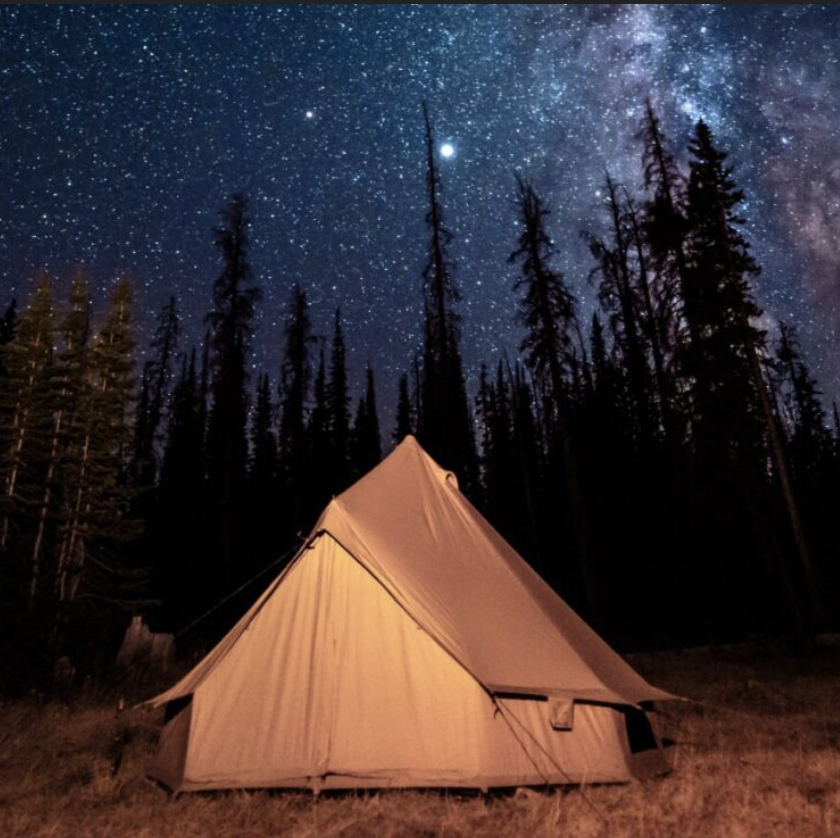
I’m trying to set up this tent in
the dark.
Not city dark,
Not country dark,
Wilderness Dark.
I’m trying
to line these wiggling
poles up with the tent seams.
I’m trying
to hold this flashlight between
my cheek and shoulder.
I’m trying
to get this impossible
rain tarp in place.
I’m trying to be happy and patient.
I’ve tied my children to trees.
They’re calling me
to untie them
so they can help.
I’m trying to do this myself, and I will.
It’s a good thing I tied them
Up Tight
so if they fall asleep they
Won’t
Fall
Over.
I’m trying to
drive these anchors into rocks,
or some close stony relatives
and ignore the name Rex just called Syd.
I’m trying to fling our food
over this branch, fifteen feet
above our heads so the bears
don’t eat Kate for breakfast.
I’m trying to set up this camp
so I can untie my children
and lead them straight
to the tent and zip them in.
I’m trying to
put the sleeping bags on places without roots or rocks
and I’ve done so for everyone but me.
We sleep. They sleep. I try.
I awake.
My children are outside, unroped, in the light.
Something big is going on.
I try to listen. I cannot hear words.
Hushed tones of astonishment,
admiration. A large splash.
Whoops and hollers.
I try to figure out
why the ranger didn’t tell me
there was a drop
off, 60 feet,
into the lake
on the border
of my campsite.
I try to figure out
how I set up the tent
five feet from the edge
and didn’t fall in.
I try not to think of how
I tied my three children to trees
On
the
edge
of a cliff.
Same Old Cabinet
In my kitchen, the cabinets began
springing off the wall.
Behind their closed, crooked doors,
seams had separated, and
steadfastness slipped away.
I moved deliberately,
opening doors with care,
stacking dishes gently.
I was tentative and alert,
eyes fixed on the cabinets’
shuddering sinews.
I wanted to bolt.
The weight of their fall, I knew,
would break me with it.
I imagined myself,
broken boxes where
my body used to be,
The wicked witch, only
striped socks and pointy shoes
to show for myself.
Even then, I doubted. I discussed
the situation with friends: “Are you
seeing what I’m seeing?” They nodded
and said, “We told you this already.”
I called the carpenter. I learned the cabinets
could be fixed, but first I’d need to empty them.
I weighed out danger verses
upheaval before telling him yes.
On all my flat surfaces, I built
wobbly stacks of plates and glasses,
jars and cans. The carpenter left behind
gouged walls and a fine dust
that filled my lungs.
Outside the kitchen’s empty, ugly landscape,
I organized the chaos, carving out space
to eat, and work, and dream.
In the carpenter’s shop, the shaky seams
met with glue and screws,
And I came home to find the cabinets
hanging again, straight and true
That day, and the days following, I had no
desire to put everything back.
Then, I couldn’t quite remember
how it had been. I suspected the cabinets
had been mounted upside down.
Eventually I tucked it all back in.
The new arrangement was different,
but I had to admit, it was good,
and maybe, even better, than before.
My space is now safe and strong and stable.
Nothing angles out at me, threatening
to hurl a single dish or all of them at once.
But now, every time I look into the kitchen,
I still see those cabinets leaning.
I’m still running my hands along the seams
between the cabinet and the wall.
I’m not sure how long before
my eyes believe what my head knows;
how long before I stop waiting for
it all to come crashing down.
And now you’re home too, this old shape of you
that’s had a fair amount of screw and glue
to stand
you
up
straight.
I’ve gotten used to my peaceful cairns,
and I’m not sure how to move about you anymore.
I’m sorry to say, that most days,
I don’t even want to try.
What my head knows and
my heart believes are two different things.
When I look at you,
you’re still swaying.
-Chali Davis
Bringing you into the world
was a half-cocked plan,
born of accident and bravado.
Of one thing I was certain:
I would do better than my parents.
My smart resolve soon fell away
into the ruts of their well-worn path.
From the Box Store of Beliefs,
I bought a large suitcase.
Around scratchy clothes and
tight shoes, I arranged for you
all the useless nothings
Of Propriety and how.it.is.supposed.to.be.
I watched that unwieldy valise
bounce against your new knees.
I knew this was best for you
because Important Things are Heavy
and keeping a grip on Big Truths
takes tenacity and brute strength.
As the years went by,
The pillars of what I thought
I knew, what I thought was true,
Toppled.
I remembered
The dream of another way,
Of the path that says:
It is never too late to let go
of the Warping Weight.
It is not too late
For us
to slide that clunker
out the rear car door
into a backwash ditch.
Now I’m buying you a big bandana
and a stick.
I’m packing you a bundle
Of deodorant and daring
and creativity and chapstick
and sriracha and compassion
and fuzzy socks and
the salve of let.it.go and
the balm of how.it.could.be.
I will watch you set off,
A bright bandana ball bobbing behind you.
Yes, that will be a happy way to release you into the world.
My 3 year-old daughter sat perched in her car seat as I drove my truck along the quiet country highway. She chattered to herself and my thoughts slipped to a place far away, a place that had become like a dim, lurking monster. I wondered how long it would be a threat, and how many more of our own would fall prey to its insane terror.
It didn’t feel like December 1st, and I thought of how dim this holiday would be. I mused that perhaps people wouldn’t put up their lights as always. In fact, there didn’t seem to beany up at all. I hadn’t given much thought to holiday celebrations, everything seemed quiet, low key – and the spiraling economy only added to my dampened spirit.
My broodings were abruptly brought to a squealing halt as we turned off the highway and onto the main street of a quaint New Hampshire town.
“Looook Mama, Looook! The lights! OHHH! Can we get some of those?!”
Her enthusiasm should have broken my windshield; her shrieks reached to upper registers only heard by dogs. Her reveries would silence as she peered ahead, waiting for the next glimpse of glittering sparkles and then, once spotted, her cheers would resound through the cab.
It continued on – each window, tree, bedecked reindeer eliciting pure happiness, joyful exclamations, and sounding claps. I joined in, laughing and filled with incredible joy. I realized then and there that it is impossible to be glum when you are in the company of a three-year old who is experiencing Christmas lights.
This is the season that came with a promise and a hope, I thought, and in the quiet moments between the lights, I decided to hold my friends and family a little tighter this season and greet Christmas morning with great hope. And I promised myself that if my thoughts ever started a downward spiral, I’d bundle her into the truck and we’d go look for lights.
 Chali Davis